Reinforcement Learning for Balatro
May 15, 2026 · Anjaneya, Ethan, Ajay, Ivan
I assembled a team of friends to train a Balatro agent for our Reinforcement Learning final project. We had all recently watched The Thinking Game and were convinced Balatro is the natural next step after Go.... This is a writeup about what we built and learned.
Simulator
Interestingly enough, there hadn't been serious attempts at building a Balatro simulator for RL in a performant language. There were a couple attempts written in Python but they only covered a subset of the game. The most successful documented attempts trained directly on the Steam game through mods. Immediately, we concluded that training on the true game was far too slow. Simple napkin math told us that for a serious RL attempt, we would need to rollout many magnitudes faster than what was possible on the real game. Graphics are slow, sims don't have graphics. With recent advancements in agentic coding, we felt confident in reaching parity between our sim and true Balatro.
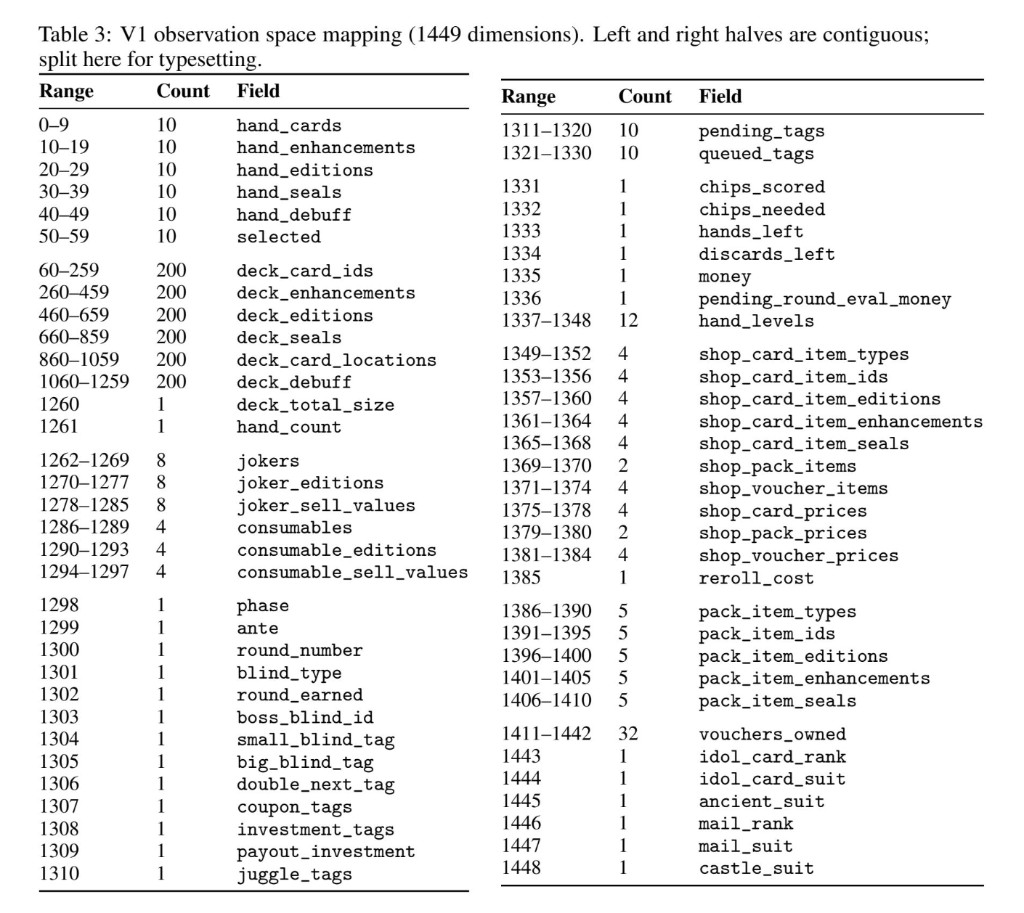
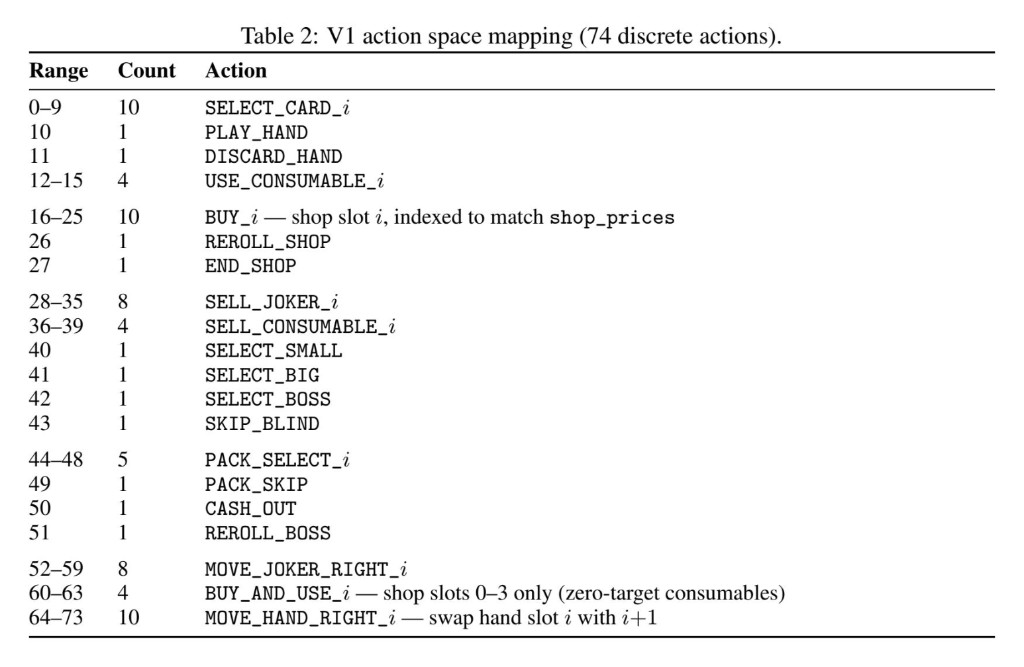
We wrote the simulator in Rust but interfaced with Gymnasium via Python bindings. Our scope was ambitious. Eight antes, red deck, white stakes, full game unlocked. Additionally, we wanted 100% parity to the true game. This large scope led to a massive observation and action space. Specifically, 759-dimensional observation vector and 135 discrete actions each turn.
Note that this was our first attempt at designing the spaces. We've since made big improvements to the model which let us reduce the action space 40%.
The observation space is a flat vector which we packed as much game state info into as we could. Some of the info includes the card information for the entire deck, jokers, consumables, shop, vouchers, chip targets, ante boss, money, etc.
The action space included card selection, play, discard, shop buying, using consumables, joker reordering, hand reordering, and more.
We implemented every feature from true Balatro. This includes poker hand detection, chip scoring, Joker scoring, recursive triggers, money system, boss de-buffs, and more. However, the most important feature we implemented is the RNG system. Balatro is filled with random event streams which each have their own RNG key. Examples of streams are deck order, shop contents, pack contents, vouchers, bosses, and more. Balatro's game engine, LÖVE, is Lua based. Through investigation, we found that the LuaJIT complier uses Tausworthe 223 for random number generation. This discovery allowed us to fully replicate the RNG system, enabling us to check-expect our sim's runs against true Balatro.
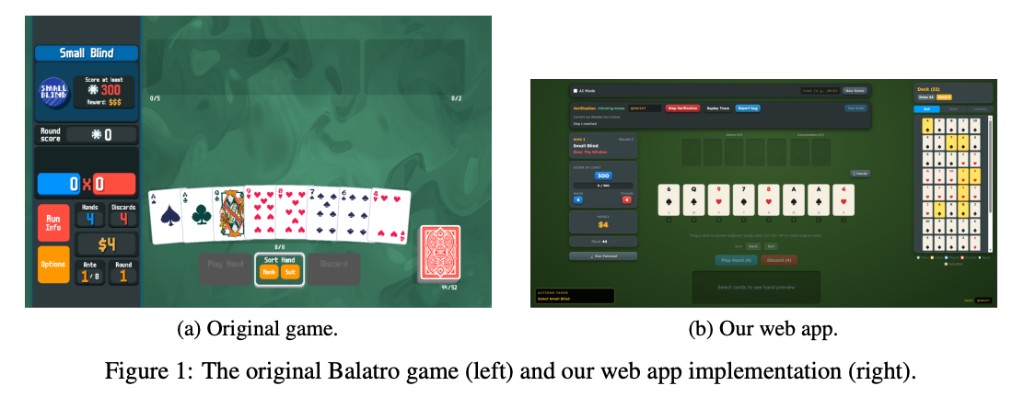
The verification system built ended up being more important than the logic of the sim itself. If a run on our sim drifts from a true Balatro run, then the agent will learn nothing. So, closing the sim to real gap was P0. TLDR; We made a web app for our sim so we could manually play it. The rest of the system mirrors our actions on the sim web app to true Balatro via mods.
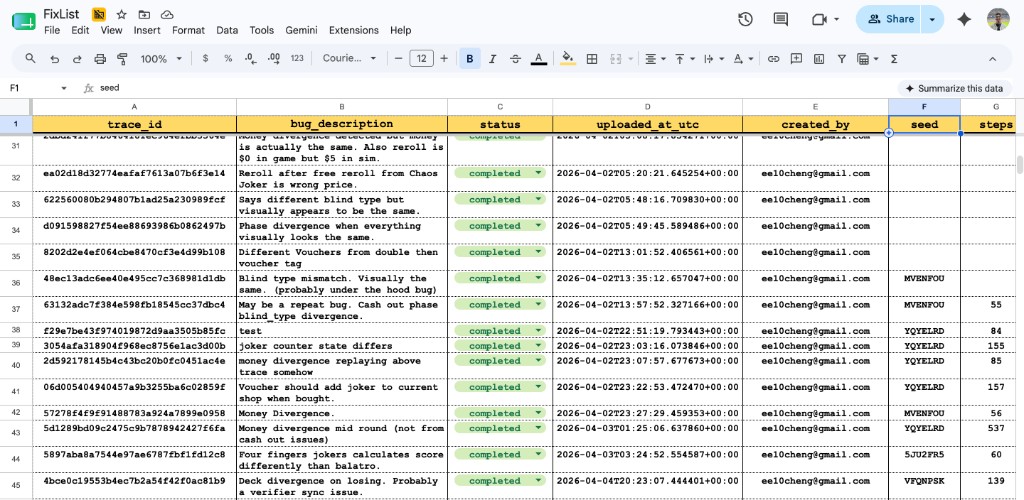
This was a great start but sharing bug traces between team members was challenging. So, we built a cloud system! When one of us encounters a divergence mid-run, our system lets us push the full run trace to Google Drive and manage the status of the bug. For each divergence, we stored a trace id, seed, and every action up to the mismatch. Then we added some quality of life feature which let us automatically replay traces. The screenshot below is a peek into the Google Drive system.
From here, the plan was to take a decent trained policy, let it play long rollouts in the sim, mirror those same trajectories in the real game, and diff the states automatically. In theory, this would let us find far more bugs than what we could manually. But our manual testing got us far enough to be confident in training!
Training
We built the complete sim first because we knew it would let us train on a multitude game scopes. We quickly learned that our initial scope was far too big. Luckily, our strong sim let us train on episodes as short as a single hand. So, we trained on single hand, one round, one ante, eight antes, and a lot more. In the end, we simulated over 1B training steps across all training. The following is some of the reward schemes we implemented for eight ante episodes.
Rewards
Our first sparse reward scheme was very bare. You get +1 for clearing a blind. If you play a hand and still have hands left, you get chips scored divided by the blind target, capped at 1. If you run out of hands without clearing, the episode ends at -1. Shop moves, discards, rerolls were all zero.
The dense reward scheme was much more interesting. We rewarded played hand quality (Full House > Two Pair), remaining discards, urgency when you're low on hands, and added softer penalties for dying late in a run. We also added penalties for crossing interest tier boundaries (saving money when interest is capped)and rewarded for buying jokers in shop.
Note that we had single-policy and multi-policy attempts for this work. The reward schemes above were tried on both. Also, we basically added these rewards and ran for 200M+ steps. Since then, we've developed much more detailed reward schemes for each part of the game.
Multi-Agent
Our thesis for trying multi-agent was that blind play and shop play were different enough to justify their own models. Shop play is much simpler in action space but requires much deeper thought and long term planning. Blind play requires the mechanics of chaining strong poker hands with jokers. On top of that, there was a bunch of model architecture we wanted to try out which benefited from a decoupling. So, we split it into two RLlib policies, blind_agent and shop_agent. Rust projects the game state into a different observation for each one. The blind agent acts during hand selection. The shop agent acts in the shop, pack openings, and blind select. The image below is a diagram of the agents.
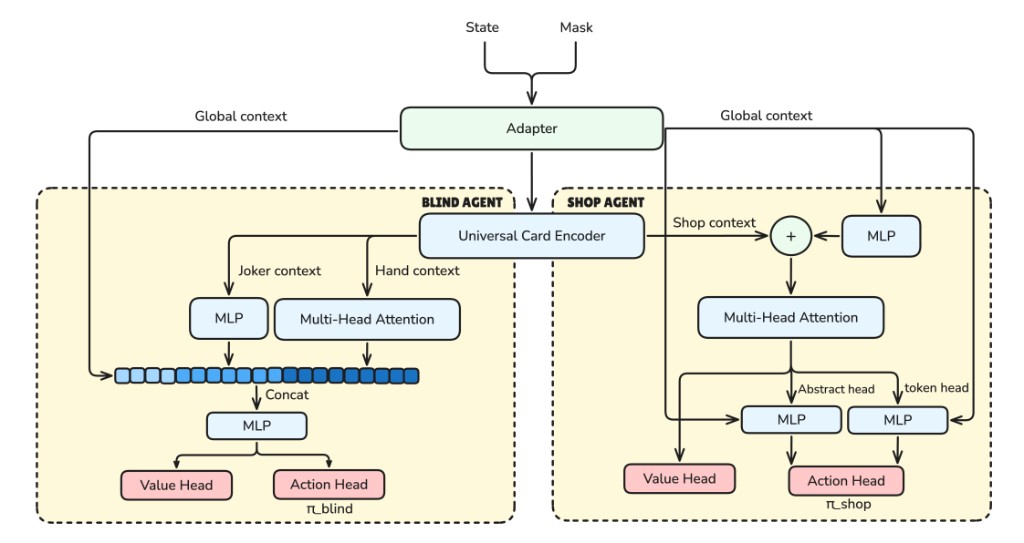
The full architecture could use a blog post of its own so I won't go into that much detail but the blind policy doesn't pick from 135 actions directly. Instead, it uses an autoregressive head that picks play or discard, then toggles cards one at a time until it commits. We called it choose-or-stop. A flat softmax over every card selection combination is on the order of 8 Choose 5 + 8 Choose 4 + ... action space size, which is unfeasible.
The shop policy uses a shared card encoder over every item on the board. Shop slots, jokers, pack contents, hand cards. Each token gets a tag for buy, sell, use, or move. To buy something specific we do a dot product between an intent vector and that card's embedding. Reroll, end shop, and skip blind got their own heads. We tried treating those like regular shop items and it didn't work. The shop entropy had to decay over training. Otherwise it would reroll forever or leave the shop immediately within a few hundred iterations.
The agents were trained simultaneously with Ray RLlib multi-agent PPO. We batched hundreds of games stepping in parallel through the Rust vec env. Our main local run used four env runners on an RTX A5000, about 20.5M environment steps over 4,000 PPO iterations. On the Duke cluster, we pushed it to 32 runners with 32 envs each.
Charts
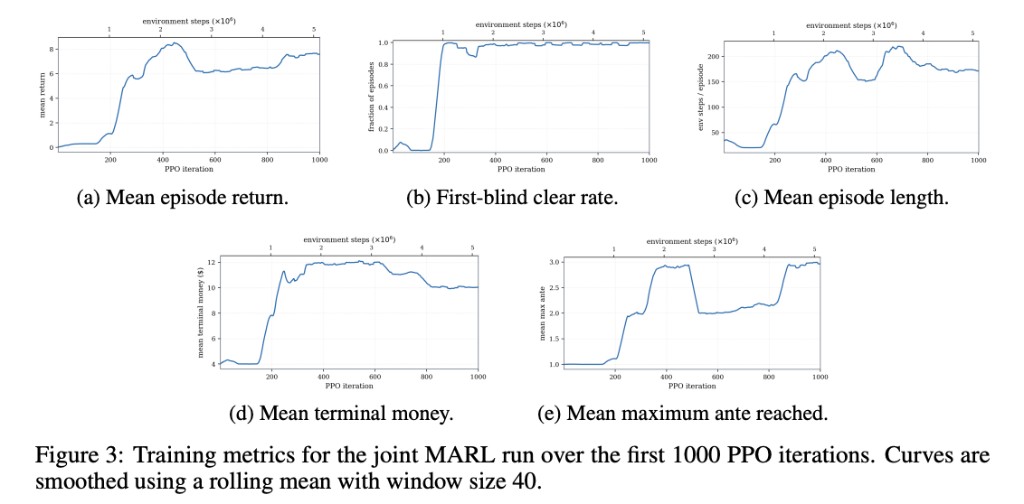
These are the charts four our most successful Multi-Agent training run. For the first ~150 iterations the agent basically dies at the first blind. You can determine this through the near-zero reward, short episodes, and little amounts of money.
Then around iteration 150 everything gets better! The first-blind clear rate goes from near zero to ~99% within about twenty iterations. The return jumps and episodes get much longer because the agent was finally reaching the shop with some money. The mean ante climbs toward 2 and then plateaus around 2.6 to 3.
So, in the end we didn't win any runs.... A full run is eight antes and we top out around ante 3 on average. The variance does let us get to Ante 4 occasionally but that is mostly shop RNG and different joker paths. The blind policy isn't really getting better at that point. We only plotted the first 1,000 of 4,000 iterations because that's where the interesting part is.
Our analysis of what happened is that the blind policy greedily learned to play easy hands like pair and two pair. We also think the 99% first blind win rate can only be explained by an agent that doesn't want to save discards (non-optimal play). Through a pair and two pair strategy and random joker purchases, the agent can get quite far!
Conclusions
Beating Balatro with RL is definitely still an open problem. We're pretty happy with how far we got in the two month time frame. Coolest part was watching it learn some hands and reliably beating ~2 antes. The best part was working on a technical project with my close friends Ethan, Ajay, and Ivan. We spent probably ~100 hours together working on this and definitely got closer as a result. Even though we didn't make a Stockfish for Balatro, we had a lot of fun. Also, we got an A+ on the project which was great. I think our professor enjoyed the presentation.
A few of us are still working on the project. Specifically, we're trying to solve hand play. Shop and economy is important but we think transferring extremely strong hand play is the key next step. We want the agent to be able to play any hand situationally, fish, and play to maximize discards left. Follow up articles on that progress is in the works.